
How Fluid Bed Dryer Technology Supports Product Quality and Process Consistency
In industrial manufacturing, achieving the required moisture content is only part of the drying objective. The finished material may also need to retain its particle structure, flow characteristics, appearance, chemical stability, or suitability for subsequent processing. In applications involving powders and granules, differences in moisture content can influence handling, storage, packaging, and the performance of later manufacturing stages. Fluid bed dryer technology addresses these requirements by combining controlled airflow with heat transfer and particle movement.
JSK Engitech provides a fluid bed dryer guide on its website for readers exploring this industrial drying method. Understanding the relationship between equipment design and product quality helps manufacturers determine where fluidized drying may fit within a broader production process.
The Connection Between Drying and Product Quality
Moisture affects materials in different ways. Excess water may contribute to agglomeration, poor flow, storage difficulties, or changes in processing behaviour. Removing too much moisture can also be undesirable when a product requires a defined residual moisture range. The objective is therefore not simply to dry material as quickly as possible, but to achieve the specified condition without compromising product properties.
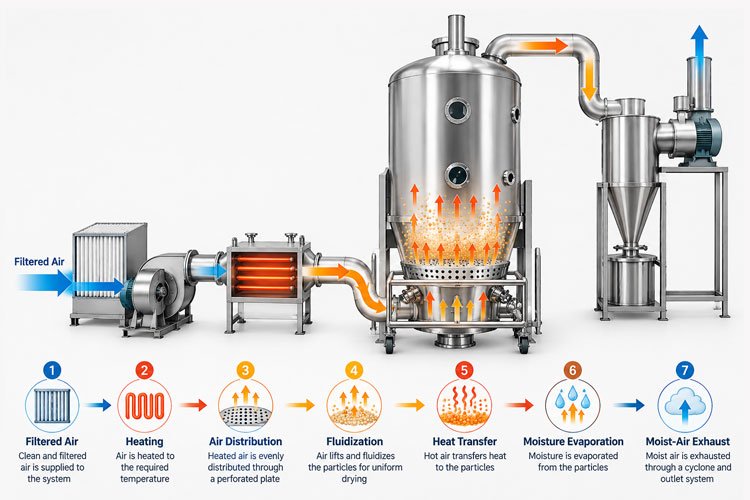
Fluid bed dryers suspend and mix suitable particles in a controlled air stream. This movement promotes contact between the particles and the drying medium. When airflow, temperature, loading, and process duration are correctly managed, the system can support repeatable drying conditions. Actual uniformity must still be established for the specific product and equipment configuration.
Why Moisture Uniformity Matters
If one portion of a batch remains wetter than another, the material may behave inconsistently during storage or subsequent processing. For example, some granules may flow differently, while other portions may have a different tendency to form clusters. These variations can complicate downstream operations and make the finished batch more difficult to evaluate.
Uniformity depends on the initial material condition, particle characteristics, air distribution, product loading, and drying endpoint. A well-designed process should account for the potential differences within the bed instead of assuming that every particle dries at precisely the same rate.
Heat Transfer and Moisture Movement
During drying, heated air supplies energy to the wet material. Moisture evaporates from exposed surfaces, while water located within particles may need to move toward the surface before it can leave the material. The speed of this process depends on the physical structure of the product, its moisture distribution, temperature, and surrounding air conditions.
Fluidization improves contact between moving particles and the drying air, but it does not remove every limitation associated with internal moisture movement. Some materials dry rapidly at first and then more slowly as their moisture content decreases. Recognising this behaviour helps operators avoid ending a cycle too early or extending it unnecessarily.
Managing Product Temperature
The temperature of the incoming air is an important control variable, but it should not be confused with the temperature experienced by the product. Evaporation consumes energy, and the product temperature can change as the material becomes drier. The relationship varies with the material and the stage of the process.
For heat-sensitive products, the process should be designed around appropriate product-quality limits. Excessive thermal exposure may alter sensitive ingredients or physical properties, depending on the material. Manufacturers should establish suitable operating limits through relevant process knowledge, testing, and quality assessment.
Applications Where Consistency Is Important
Pharmaceutical Granules
Pharmaceutical manufacturing may require granules to reach a controlled moisture condition before blending, compression, or another downstream operation. Variations in residual moisture can affect handling and may influence the behaviour of the material during later processing.
In such applications, drying parameters should be linked to the established product specification and manufacturing procedure. Batch records, appropriate sampling, equipment cleaning, and process qualification may be necessary according to the product and applicable quality requirements.
Food Processing
Food products can be sensitive to temperature, moisture, and exposure time. A suitable fluid bed drying process must account for the product's composition, particle structure, hygiene requirements, and intended use. Moisture reduction should be assessed alongside the quality attributes relevant to the product rather than being treated as the sole measure of success.
Chemical and Industrial Granules
Industrial chemicals and granulated materials may require drying to support storage, handling, blending, or packaging. Their response to heat and airflow depends on their chemical and physical properties. Some products may require additional measures to control dust, prevent degradation, or protect workers and equipment.
Process Variables That Influence Drying Performance
Consistent results require control over several interacting variables. Adjusting one setting without considering the others can create new problems or make an existing problem more difficult to diagnose.
- Air inlet temperature: Influences the heat available for moisture removal.
- Airflow rate: Affects fluidization, heat transfer, and the potential for particle carryover.
- Initial moisture: Changes the amount of water that must be removed.
- Particle characteristics: Influence suspension, mixing, and internal moisture movement.
- Bed depth and loading: Affect the resistance to airflow and the movement of material.
- Drying duration: Determines the time available for moisture removal but must be related to the actual endpoint.
- Exhaust conditions: Help describe how moisture-laden air leaves the system.
These variables should be evaluated together during process development. The appropriate operating window is specific to the product and equipment and should not be copied directly from an unrelated application.
Using Measurements to Verify the Drying Endpoint
Time alone is not always a reliable indicator that drying is complete. A fixed cycle may be convenient, but its effectiveness depends on the consistency of the incoming material and the stability of operating conditions. Variations in initial moisture, loading, or ambient conditions can change the time required to reach the target moisture content.
Manufacturers should establish a suitable endpoint method for the application. Depending on the process, this may involve validated sampling, moisture analysis, temperature trends, exhaust measurements, or other approved monitoring methods. Indirect indicators should be correlated with the required product quality before they are used as the basis for process decisions.
Why Representative Sampling Is Essential
A single sample may not reveal variation throughout an entire batch. Sampling procedures should account for the possibility that different regions or portions of the material behave differently during drying. The required approach depends on the product, batch size, equipment design, and quality specification.
Where batch uniformity is important, the sampling plan should be designed to provide meaningful evidence that the material meets the established requirements. Sampling and testing procedures should follow the applicable quality system.
Equipment Design and Cleanability
Product quality can be affected by more than the drying cycle itself. Product-contact surfaces, seals, filters, air handling components, and discharge arrangements may influence contamination risk and cleaning effectiveness. In multi-product facilities, residue from a previous batch may create quality concerns if cleaning procedures are inadequate.
When evaluating a fluid bed dryer, consider access for inspection, the design of product-contact components, cleaning methods, filter arrangements, and the potential for material accumulation. Pharmaceutical and food applications may require additional design features or documented cleaning controls depending on the product and applicable standards.
Common Quality Problems and Preventive Measures
Uneven drying, unexpected agglomeration, excessive fines, and inconsistent final moisture can have several possible causes. Troubleshooting should begin with observations and process data rather than immediate adjustments to a single operating setting.
- Review the incoming material's moisture content and particle-size distribution.
- Check whether the product load and bed depth match the established procedure.
- Inspect airflow distribution and filtration components according to the maintenance procedure.
- Review temperature records and the method used to determine the drying endpoint.
- Investigate changes in raw materials, preparation steps, or equipment condition.
- Document approved process changes and evaluate their effect on product quality.
Conclusion
Fluid bed dryer technology can support controlled moisture removal and consistent product handling when the equipment is properly matched to the material. Its effectiveness depends on airflow, heat transfer, particle behaviour, appropriate endpoint verification, and Fluid Bed Dryer suitable equipment design.
Manufacturers seeking dependable drying results should establish product-specific operating limits and verify performance through relevant Fluid Bed Dryer measurements. The JSK Engitech fluid bed dryer guide provides a starting point for understanding the equipment, while application-specific testing and process controls remain essential for achieving the required quality.
Comments on “Fluid Bed Dryers for Modern Manufacturing: Efficiency, Quality Control, and Long-Term Performance”